“What do you think of the orange trees around town?” he said.
“I love to look at them,” I said. “They make me feel peaceful when oranges are in season. Why do you ask?”
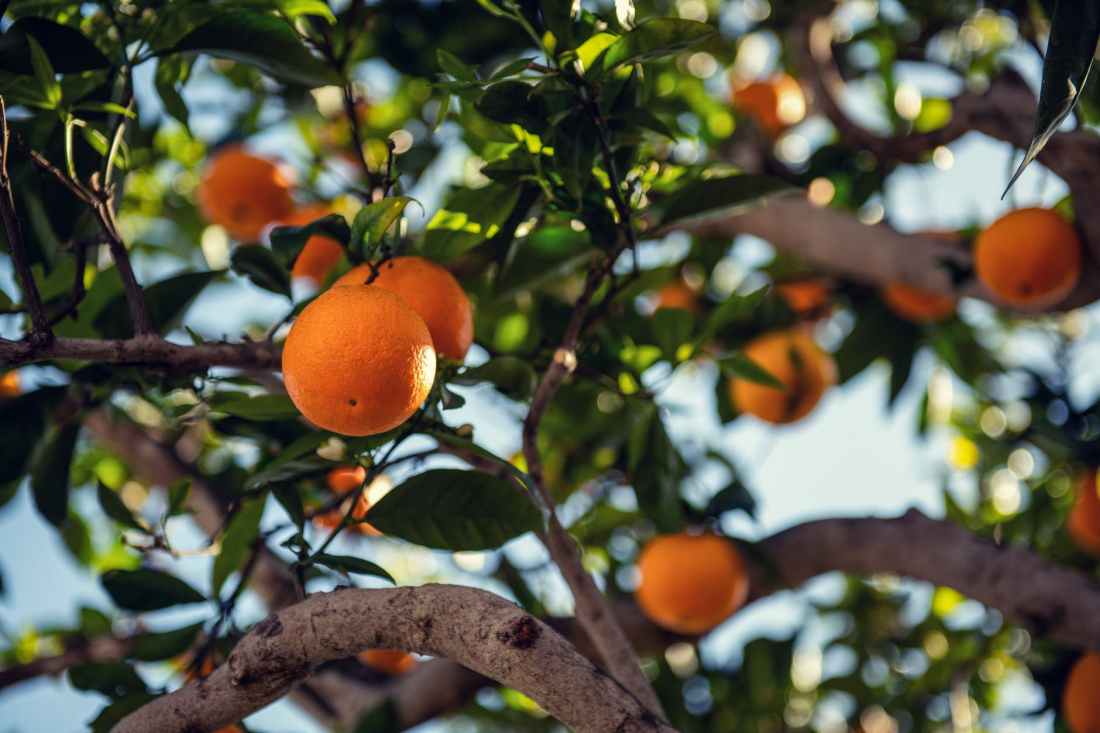
“Because I love to look at them too,” he said. “They are beautiful, but one day in Capitol Park I tried to eat one. It was horrible. I lost my inspiration.”
“I guess oranges can be like people,” I said. “They appear great, but once you get into them they might not be. That doesn’t mean we shouldn’t make ourselves beautiful on the outside. It means we should try to be as attractive with our personalities and souls as we are with our nice clothes. It also works the other way. If you are a wonderful person, dress like it.
“The orange trees in Capitol Park are great. They are old. All the oranges don’t taste terrible though. You just have to keep experimenting.
“I remember sitting with a 90 year old and his wife. They had just picked a plastic grocery bag full of oranges and were eating some. They do it every year. They think the oranges taste sweet. I think if they get any less sweet they would not be good.
“Looking at oranges fills me with inspiration too. In November when they get orange, it gives me hope as the days get real short. I never think of oranges as being anything but sweet. It’s a good thing to think about for Christmas. How to be sweet.
“Jesus was sweet, though we never think of him that way. Oranges are a great tonic for our bitter times and for our city which is home to all the bitterness from throughout the state.
“I wish they’d fertililze the trees so the fruit would be sweet. It would be great to have fresh squeezed orange juice at the capitol a couple of times a season. What pride and class our state would have. Our city would glory in it.
“Were you in a hurry when you ate it?” I asked.
“What?” he said.
“When I see people in the park eat an orange, they devour it, or try to. They are just hanging around the park, then they slop like they have to be somewhere and don’t have time to eat.”
“I wasn’t in a hurry,” he said. “I wanted to sit and savor it, but I was disappointed so I left.”
“I know what you mean,” I said. “A lot of times I’m disappointed when I look at the oranges in December and January. They are bright and still, so peaceful in the fog. I look at them with all my bitterness and long for my peace and sweetness. I sit to make peace with myself as I marvel at the beauty of the oranges. If the sun breaks through, I think how lucky I am and how great life is.
“I think of how lucky we are to live in California. It is paradise. I mentioned that they ought to fertilize the trees to serve juice in the capitol. It would be a great way to celebrate living in paradise.”
“You’re right,” he said. “The weather here is great.”
“We’ve always known that,” I said. “In 1909 somebody in town wanted to start an Orange Day to make tourists from the east aware of how great our climate is. The plan was to plant orange groves in land visible from the railroad and orange trees at train stations.
“People would see proof our climate is mild and that our oranges taste better and ripen a month earlier than oranges in the Southland. We wanted to outdo LA, but the cultural importance of life in California had shifted from the north to the south.
“I did not find out how successful planting with a view for train travellers was. I never saw another notice of Orange Day. I see eucalyptus along train tracks and around stations. Eucalyptus look mysterious and sensual all year. Orange trees only attract when oranges are on them.
“Starting at the end of the 1800s a lot of orange trees were planted in Fair Oaks and Orangevale. In 1930 the Chamber of Commerce planned an Orange and Flower Festival. One occurred in 1931.
“That was when camellias were beginning their run to prestige and popularity. I think between our fame for our trees and the passion of camellia lovers, there wasn’t room for oranges to be glorified.”
“Actually we call ourselves the Camellia City,” I said. “Just like we call ourselves the City of Trees. We’re called the River City because the rivers were always here, and we used to be called The City of the Plain because we are on a plain. People wanted shade so we planted trees and people wanted beauty so we planted camellias. It’s natural that we are proud of our trees and our camellias.”
“That’s an awful lot of names,” he said.
“Maybe that’s why we have an identity crisis,” I explained. “It’s too bad we can”t get our city and county tourist departments; the chamber of commerce; and the marketing, advertising, publicity and public relations communities to make some order out of our names.”
We paused.
“I’ll be happy to tell you what I know about camellias if you want me to,” I said.
He nodded.
“A lot of my facts about camellias I got from a book by F. Melvyn Lawson. I read it in the Sacramento Room at the main library. Camellias came here during the Gold Rush. Because of all the people here, most ot the trees along the shores of the Sacramento were cut by 1853. While the old trees were dying the beautiful camellia was making itself a home. The guy who sold trees at his nursery, James Warren, also sold camellias.
“The camelllia got its second break in 1869 when it was planted at the State Capitol Park. From then on the enthusiasm of camellia growers and lovers got even stronger.
“In 1910 people tried to call Sacramento the Camellia City, but it didn’t catch on. That’s interesting because that was at the same time the neighbors in East Sacramento wanted to tear out the old plants and walls at the cemetery on Alhambra. The cemetery had not been maintained after its heyday between 1855 and 1875.
“While one was falling apart, the other was taking fifty or sixty years building itself for fifty years of glory. A lot of shade trees were being planted too. The difference between the shade trees and camellias was that nobody wanted to cut the camellias down. At the beginning of the century, C. K. McClatchy used to criticize business owner for cutting down so many beautiful old trees that had been planted between 1850 and 1870.”
“But don’t camellias need shade?” he asked.
“Yes,” I said, “but they were always planted in parks or at people’s homes. They weren’t planted in the shade of street trees. So with their beauty, their lovers and no competition, the camellia became Sacramento’s most cultivated and famous flower. In 1941 it became the City’s official flower.”
“When did we become the Camellia City?” he asked.
“In 1943,” I said, “when the Camellia Society promoted the name, although one horitculturalist referred to us as Camellia City in an article he wrote in 1927.”
“I don’t see too much excitement around town about camellias,” he said.
“It’s around. It just isn’t what it used to be,” I said. “Everything has its day. The camellia had quite a long day. From about 1925 to about 1975 were its glory years. So except for just a few years, the camellia was growing steady or riding high from 1855 to 1975. That’s a real long time in the modern world.
“I have my thoughts as to why it is not as popular as it used to be. There wasn’t much winter color in those days. The Sasanqua camellia and poinsettia in December, narcissus in February and the regular camellias in February and March. Now there is a lot of color all year.
“Another reason is that camellias require TLC. People don’t have time to work in the garden or to observe something beautiful. The old school people used to sit in their lawn chair on a sunny Saturday in late winter and watch the blossoms. Then they’d snip them and put them on the dining room table.
“The world has changed. Water became scarce. Plantings that would have gone to camellias now went more and more to drought tolerant plants.
“One last reason I can think of is that between 1960 and 1980, Sacramento lost more of its wide open spaces. The camellia symbolizes civilization. With civilization everywhere, people need wildness. The wild free look is in – poppies and zauschneria.
“But it isn’t important to me why the camellia is not as popoular as it used to be. It is still lovely. What is important is that it was a source of a lot of passion, that it inspired so many people for such a long long time.”
“Even though they are big and beautiful,” I said. “They aren’t the trees people mean when they say the City of Trees. People think of elms and sycamores in neighborhoods.
“Cottonwoods pretty much grow along our rivers. My favorites are along the Sacramento off of 35th Avenue. So many of them growing tall with all that space for light play fit the wide expanse of river there. Everything is majestic.
“I feel I am in a different world. It’s quiet, especially when leaves flutter in the wind.
“I like to sit looking at the reflections of the trees in the shady water, then to the sky beyond the levee.
“It’s a place to live the moment, sitting with your feet in the water watching the river flow, thinking of your failures as you feel lucky to be surrounded by what is most important. You imagine you see your kids on the other side of the river standing on the levee going off to pursue their dreams, or returning from the big sky on the other side to tell you how their dreams turned out.
“You think of people who came here who couldn’t wait to see the confluence of our rivers. They’d make their way through the cottonwoods, seeing a big bend in the river in the distance, the sleepy trees and brush leaning over the water.
“They’d wonder what was ahead for them, around the next turn, why life is usually lived going upstream, if they would ever learn to flow and go where their power and beauty takes them.
“At the confluence they’d sit together. They’d see water sparkle and light play on leaves and trunks. They would wonder if people could merge like this.
“At night in summer they’d walk through the trees to where the rivers meet, turned on by the shape of the cottonwoods’ trunks. They’d smell damp earth and dry grass. ‘The kids will love it here,’ they’d whisper.
“They’d walk faster, horny from heat and hanging vines, loving crickets and the stars between trees.
“You think of what it must have been like when they saw the water through the trees, how badly they wanted to come together.
“From the edge of the trees they’d sit and talk things over, about what it means to merge, to create something basically like you but greater and more beautiful. All night they’d linger, their future twinkling in the sky. They’d watch water from the mountains ease toward them. They’d let their past flow away in the dark.
“They’d dream of giving everything they have, of being there forever for each other.
“It must have been scary, trusting on something as fickle as nature, knowing that things could not always be contained, that they would surge over the boundaries, that some years one flow would trickle and only one of you would sustain everything.
“There must have been times when they’d wander alone along one of the rivers wondering what happened, grateful for their children, walking until the stars came out, until dawn, when they were as far from the confluence as they’d ever been.
“The strong one left behind would look to the mountains for strength, asking why they all weren’t there with the mountains and rivers and trees – everything you could ask for.
“I ask myself all the time why a freeway is over the confluence, why we call the merging Discovery Park when it’s too noisy to discover love and permanence, things that are most important and we desperately need.
“I think of the weak one wandering back to the confluence, the passion they both felt as they watched the mountains, vowing to be true to themselves.
“They’d think and dream about the kids, knowing time was moving on like the rivers, hoping everybody would age like cottonwoods.
“It’s difficult,” I said, “to feel graceful like cottonwoods when I watch the river flow and see the mountains. My dreams were huge.”
“Have we always been the City of Trees?” he asked.
“Yes and no,” I said.
“When the pioneers starated rolling in, Sacramento had trees everywhere. People valued the trees for the shade. Remember there weren’t swamp coolers or fans in those days. But they also needed trees to build and to use for fuel. A lot of people who got here didn’t have a place to live. They built fires against the trunks of the trees. That’s how big the trees were.”
“Then the trees fell over,” he said.
“I guess so,” I replied. “I guess property was damaged and people killed or injured when fires finally burnt enough of the trunk so trees fell, or were so weak when the rains and floods came they got knocked over.
“A lot of trees burned in the citywide fires of 1852 and 1854. Between the cutting and the burning, we weren’t the City of Trees we were when we started. The settlers though, needed trees for shade, even if they didn’t need to build anything else and they had a wagon to haul fuel in from somewhere. They started planting trees everywhere.
“I don’t know when we became the official City of Trees. We started getting famous for our trees in the 1880s. When C. K. McClatchy returned from Paris in 1911, he wanted to make us a city of trees like Paris.
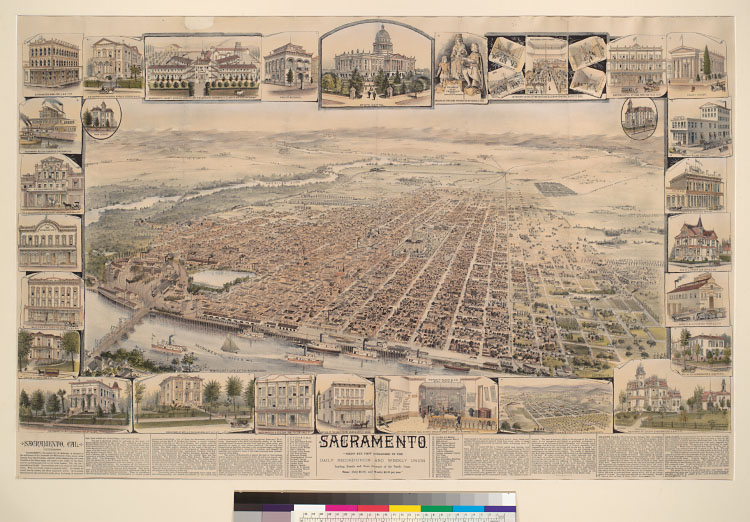
“When I look at art from the 1800s that depicts Sacramento, the name I see is The City of the Plain. It’s a lithograph by George Baker done in 1857. The inscription under the lithograph reads:
A BIRD’S-EYE VIEW OF SACRAMENTO
The City of the Plain
“So he got his image from looking down from the mountains?” he asked.
“I don’t know,” I said. “There weren’t airplanes. Maybe there was a three story building he viewed the valley from.
“What amazes me is his detail. The lithograph depicts the trees in town to be part of an overall tribute to the precision of city planning and commerce on a flat wilderness. Baker has the space between Sacramento and the mountains all flat. More like geometry’s plane than grassland. He considered a plain to be boring, rather than teeming with life like Indians and John Muir did.
“He makes it look like a vast distance of flat to the mountains, but it’s only ten miles to where the hills start in Orangevale.
“It seems to me he never stepped from his office to see the area a few people marveled at. There’s another bird’s-eye view of Sacramento done in 1870. I don’t think Baker did it, but the same sense of emptiness between town and the mountains exist. The two lithographs captured the boredom of the rice fields in the next century, rather than the home of wildflowers and buzzing bees that Muir walked through and lusted over and slept in.
“I like a painting done in 1849 by George Cooper. It has a lot of trees towering above buildings. Through the trees are the mountains. The painting is exciting and mysterious. It makes me think of how neat it would have been to live here and be part of the adventure.
“The lithographs of 1857 and 1870 make me feel that Sacramento would have been a great place to watch the mountains but a boring place to live.”
“Or the sky,” he said.
“What do you mean?” I asked.
“Without any trees, the sky would have been more important,” he said. “People would have been forced to watch it.”
“There’s a guy who agrees with what you said,” I said.
“There is?”
“Yes.”
“Go on,” he told me.
“He wrote an article in a local weekly paper in the 1980s. He said the old timers planted trees so they would not have to see the sky and be overwhelmed by God. I think he was saying that all the talk about God that the pioneers brought with them was put to the test after they destroyed the trees and had to look up and see God go up and out forever. It scared the shit out of them.”
“Kind of like you’re implying the grassland scared Baker,” he said.
“Right,” I said.
“So they planted trees to forget about their fear?”
“That’s what I think he was saying,” I said.
“What do you think?”
“What do I think?”
“Yeah.”
“I think people feared the plains and the sky. The fear they had from crossing the Great Plains and sailing on the ocean they brought with them here. I think they liked the sky at night, but the vast sky in the daytime was too much. It’s too bad. The Sioux saw the prairie as divine. The ancient Athenians loved to look at the vast sky and the ocean from their city. The ancient Irish saw spirits in trees. We didn’t see trees as divine when we cut them or when we planted them.
“We had it all going for us. Except for the fifteen years between 1855 and 1870, there were good sized trees. If you lost interest in looking at the trees, you could walk to the edge of town and climb one to look out at our great grassland and the mountains and peep through a space between branches to the sky. God was everywhere.
“I see God everywhere like the Spaniards wanted to name something after the Blessed Sacrament. The Spaniards didn’t see nature as divine, but they loved God. They were on the right track when they gave us a sacred name. Of all our names – The City of the Plain, City of Trees, River City, Capitol City, Camellia City – Sacramento is our best. What we need to do is adopt a sacred outlook to go with our sacred name. We can pray to our rivers and use the grass under oak trees as places to make love and have a baby.”
“And look up to the sky together when we finish doing it to thank God for life,” he said.
“Yes,” I choked.
“It sounds great,” he said. “How will you get it to happen?”
“I won’t,” I said. “But think of this.”
“What?”
“We can’t focus on rivers or trees because they are right here for us to touch and linger with. We don’t know how to touch or linger. We’re always reaching for the future. A view of the sky and the mountains symbolizes the future. The sky is limitless like the future. The mountains are monumental like we hope our future is.
“You can’t walk to the edge of town anymore to climb a tree to look to the mountains and all that sky between us and them. What you can do though is find a building with a view. If you work in a big office building you can walk out to the hall during break and look to the sky and mountains aching for your retirement. If you’re way up on one of the top floors where you can see the rivers and a few miles of trees too, you might feel magical, that life is really pretty good and your kids will be rich and famous like the mountains and all your grand kids will have a blast playing in our urban forest.
“We’re a city of everything. We always have been. That’s where our potential lies, in allowing everybody a view of what we have – our mountains, trees, rivers, the sky, the valley.
“We have the relatively new justice building. Supposedly the grand view is for the jurists, not reserved for the judges. Our next steps are to move the five floors of our library to the twenty-sixth to thirtieth floors of the newest skyscraper. Then we can have public parks on the roofs of future skyscrapers. Everybody who wanted a grand view could have one.”
“It sounds like you don’t get a view,” he said.
“The only view I’ve had was when I went to Sac State,” I said. “On my way to talk with my professors, I’d stand in the hall if it was winter and look to the mountains. It was beautiful.
“I didn’t think of my future though, of having a cabin in the mountains; a penthouse apartment; a private office with a view from the top. I thought of the past, when the air was clear and there were no suburbs and I could walk all over the valley and up into the Loomis Basin.
“Even in the old days,” I continued, “people didn’t focus on walking. They rode a horse, or on a wagon or buggy, a riverboat or train. Today we ride in cars. Our name the City of Trees would mean more if we walked. We could have a mystical passionate image of our city from walking and wondering, rather than a teenage lust to put Sacramento on the map that we have now.”
“But we don’t walk,” he said.
“No we don’t. It’s too bad because walking is one of the most important things if a city wants to be great or magical. With all our trees you’d think people would be walking around filled with wonder or excitement, but like you say, we aren’t.”
“So how do you get to see everything?” he asked.
“I don’t,” I said. “I take what I get. When I lived in Midtown I’d take the bus to see a friend off of 65th near Fruitridge. It was too far to walk, especially with all the cars and few trees.
“The ride through the old part of town and past Land Park is pretty with all the trees. Then you get to the end of the park and look south to all that sky. On clear days it’s great.
“I loved going out there in February and March when it’s clear and windy. I d get off the bus at 65th. As I crossed the street I’d look to my right and left – the Sierras looming bright white and the Coast Range a dreamy silhouette.
“When I got across the street I’d walk real slow past the cemetery to watch the spring grass blow. I’d stop and look. Then I’d start walking, turning to the sky to the south, then to the Sierras. When I got to the corner to turn off, I’d stop and gaze back to the Coast Range.”
“What about the rivers?” he asked.
“I get there when I can,” I said. “The bus ride through the trees, then out to all that sky and the views across the valley and to the mountains was and is beautiful. I feel lucky.”
“Yes,” I said. “I like to go to Capitol Park and look at the trees.”
“Which ones?”
“Italian Pines and Deodar Cedars,” I said. “Why’d you ask?”
“Because I was coming out of the candy shop on L Street across from the capitol. I noticed a beautiful tree across the street. I stopped chewing my candy to look because I was shook up. I walked over to see it. There was a sign on it like on other trees. I worte the name down – Pinus pinea – Italian Stone Pine – then I put my note pad away and looked for a long time. I touched it. When I didn’t think anyone was looking, I kissed it because it was beautiful to me. I was in a daze the rest of the day. At home I started to tell my wife about it but I started to cry. ‘They’re so beautiful and muscular!’ I cried. I couldn’t go on.”
“They fill me with passion too,” I said. “I know what you mean about trees being muscular. When I look at how bulging and powerful and peaceful Italian Pines are, I become aware of traffic on L Street. I feel and see all this power and motion, but traffic has no beauty and no peace. Even on weekends when it’s slow, there’s an uneasy stillness from the ugly buildings on L Street.
“I get sad like you do. I never had the courage to tell someone and to cry to them about it.
“There have been times I couldn’t look at them because they make me aware of peace I don’t have and power and beauty I am afraid to use.
“I watch people during lunch walk by the pines without looking at them. The Deodar Cedars you can’t help but see. The Italian Pines, even though they are huge, are easy to not pay attention to.
“I’m sure there are people who love them like us. A lot of people probably struggle with themselves as they see the beautiful powerful trees, knowing they have to return to the office to have their spirit murdered. They want to quit work to be free, but know they can’t. The trees keep them alive, yet they become more and more aware they’re dying a slow death. There are probably days they can’t bear to look, just like a man without a lover sometimes can’t look at somebody beautiful.
“There’s always somebody who loves their job, who can look at the pines and be aware of life’s preciousness, then allow it to make them love their job more.
“What did your wife say?”
“She cried with me. It isn’t that she loves trees. After we stopped crying she said, ‘That’s how I felt when I had the kids.’ We cried after that too. We hugged longer than we we ever have.”
“The guy who planted the pines,” I said. “I wonder what he felt?”
“What do you mean?”
“B.B. Redding. He was married with kids. He was mayor here in 1856. He was a philosopher, statesman, theologian and scientist. In 1870 his doctor told him he was working too hard and needed a vacation. He and his wife went to Europe. In Italy they saw Italian Pines.
“Being in a country with all that culture and history, and seeing those beautiful trees, must have moved him like they do me and you. He had vision to bring specimens back to plant around the perimeter of the capitol. There are only a few left. I guess he thought their grandeur would suit the elegance of the capitol. He was right.
“I wonder, since he was getting older and needed to restore his health, how much he realized he could never express and never feel when he saw the trees. It’s kind of a tease. Feeling greatness we can never attain, but wanting to experience it anyway and wanting other pople to experience it. What’s great about Redding is he lived a dynamic life and was a great man. I guess he thought the rest of us could be inspired to be great in our areas of interest and with our personality.”
We paused.
“You know the buildings across Tenth Street from the capitol, the ones with the quotations that are profound?”
He nodded.
“The buildings were constructed after Redding died. It’s too bad because he lived the quotations. One of the quotations is Bring Me Men to Match My Mountains. The other is Into the Highlands of the Mind Let Me Go.”
“Are those from ancient times?” he asked.
“They’re from modern poets,” I said. “I think it was masterful planning to plant Deodar Cedars on the front lawn of the capitol, then construct two grandiose buildings across from them. After looking at the two buildings and being jazzed reading the quotations, you become more inspired walking over to the capitol with the gigantic cedars from India, a place with more and bigger mountains than we have.”
“It’s a little overwhelming. Isn’t it?” he said.
“Yes,” I said. “The elegance of the three buildings; the eloquence of the quotations; the majesty of the cedars and the beauty, peace and power of the pines probably makes a lot of people afraid to set goals because we know we could not come close to what we just saw and felt.
“But I think there’s more to this than that. The buildings and quotations appeal to our ego. We see the buildings and wish we were a Greek or Roman or southern aristocrat. We read the quotations and we want to be great because we know there are only a few people like Redding who match the mountains and get into the highlands of the mind.
“The trees, as humbling as they are, play second fiddle to the buildings. Our tremendous passion to express, be ourselves and be free is overwhelmed by our desire to compete and be better than.
“It would have been better for everybody if the buildings had different quotations. If one building read Speak Your Truth and Only Your Truth, and the other read Listen to Your Neighbors Truth, we would all feel free and powerful at the same time we felt part of the community. There are a few people like Redding who will stand out among their contemporaries no matter what, but the important thing is for everyone to feel part of a community. We don’t have that.
“Imagine reading quotations like those I made up. It’s a healthier challenge to accept ourselves for who we are than to try to be great beyond our abilities. We’re unhealthy because we refuse to live our truth.
“You know that row of ugly buildings on L Street?”
He nodded.
“They stand for the grandeur we don’t live and the passion and expressiveness we deny. We can’t live the stateliness that we see in the capitol and the two buildings on Tenth Street, but we easily live the lifelessness and constraint of the ugly buildings.
“It’s a struggle for me,” I continued. “When I see the quotes on the buildings I want to be great, to be an important person who knows everybody at the capitol. When I see the trees, I feel I am not livng my passion and beauty, or if I’m confident, I’m inspired to continue to live my truth and be my self. The ugly buildings make me rage because they aren’t great, scare me because they are ugly and make me sad because they stifle my freedom and expression.”
We paused.
“I don’t know what I’ll do when the last of the Italian Pines blows over or is cut down.”
“We can plant new ones,” he said, “Like Mr. Redding did for us.”
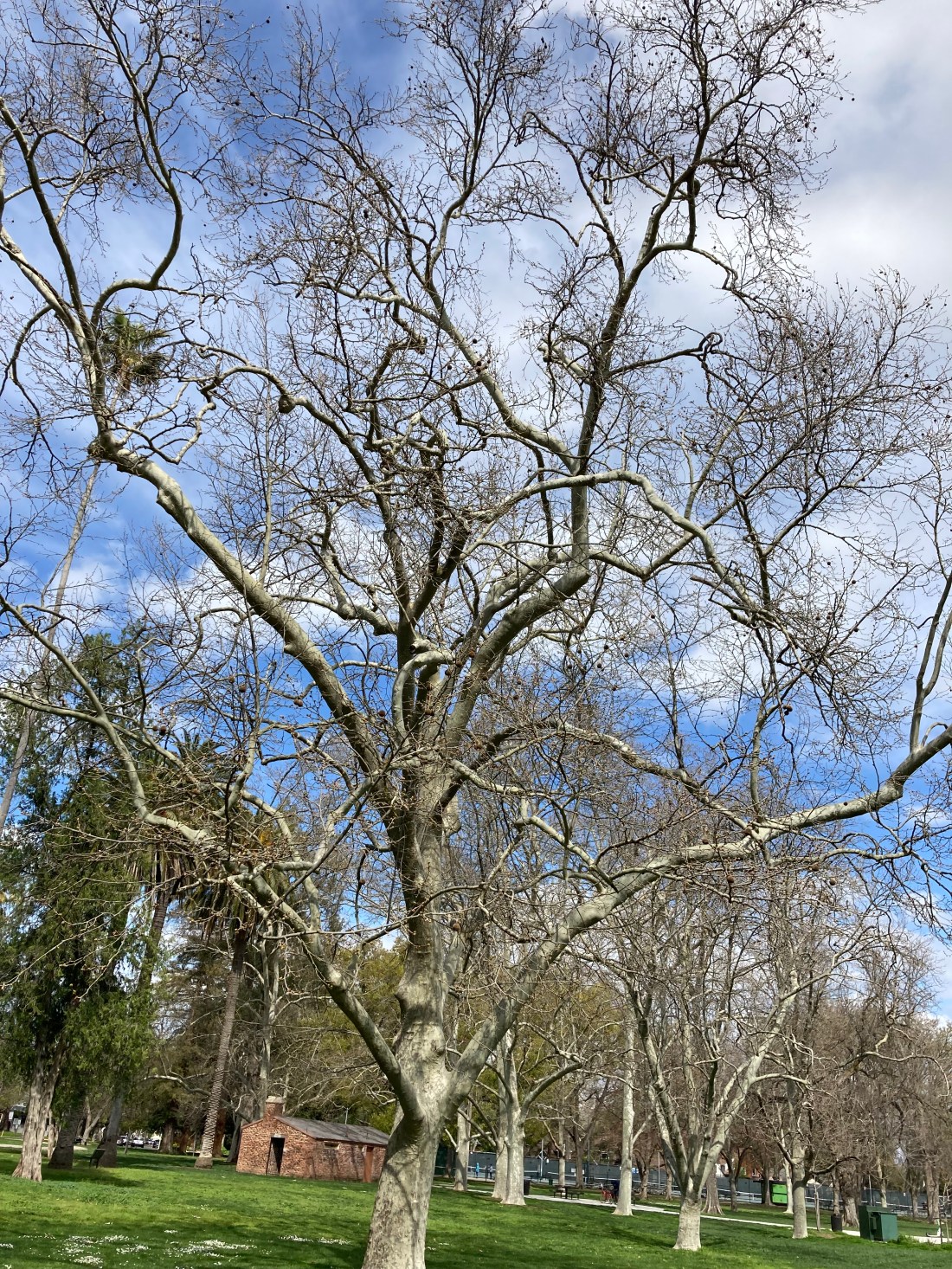
“Sycamores are one of the prettiest trees in Sacramento,” he said.
“Most everybody feels the same way,” I told him. “The trees are all over Midtown, East Sac, Land Park and Curtis Park.”
“I think they come from London.”
“Some do. Some are native to California,” I said. “Sycamores grew along the banks of our rivers. They were here when Sutter came.”
“So they left the sycamores along the river and planted the trees from London in town?” he asked.
“Not really,” I said.
“Well what happened?”
“There were a lot of trees along the shores of the river where the people who came after Sutter settled. In 1847 a guy wrote in his diary that Sacramento was ‘a town in the woods, with the native trees still waving over its roofs.’
“But people cut trees for wood and built fires against the trunks of others. Finally in 1853, the last tree that was native to the plain came down. It was on oak.”
“Then they started planting more natives?” he asked.
“No,” I said. Actually they planted Calilfornia Sycamores in 1850, way out of town at Sutter’s Fort Burying Ground where Sutter Middle School is now on I and Alhambra.
“Sutter gave up ownership of the land in 1849 and 1850. Dr. R. H. McDonald bought the land. He named the cemetary New Helvitia Cemetery. New Helvitia means New Switzerland. Sutter came from Switzerland.”
“So Dr. McDonald planted the trees?”
“Nobody seems to know. But we know that the trees on the school’s lawn at the corner of Alhambra and I are the oldest in town. McDonald could have had them officially planted, or someone who had a loved one buried there could have planted them.
“There was a lot going on. A nursery owner named James Warren was selling non-native trees to replace the natives that had been cut or burned down in town. Over at the graveyard beyond Sutter’s Fort, the guy who bought the land from McDonald in 1857, J.W. Reeves, made a beautiful cemetery with trees and shrubs and flowers. The cemetery went all the way to H Street.
“Cemeteries were a big thing in those days. According to Gary Wills, they were considered parks where the living could go and commune with the dead, themselves and nature. Cemeteries were on the edge of town not just for health reasons, but as a symbolic meaning that death is the end of one world and the beginning of another. At the edge of town in the graveyard, the living were in a spot between both worlds looking out to the wilderness, wondering where their loved ones were and what their own death would bring.
“In 1875 the City gained ownership of the cemetery. From then on it was maintained less and less. After 1912 hardly anyone was buried.
“In 1908, the people who had moved out that way wanted to increase the value of their property. They eventually got the cemetery planted in grass so it would look better, and not so much like a cemetery.”
“And of course the sycamores kept growing?” he asked.
“Of course,” I said. “I find it interesting that somethng intended to be sacred could become an eyesore and a nuisance in just thirty years.
“While the property owners wanted walls, shrubbery and trees removed from the graveyard, people in Midtown between B and H and 21st and 23rd started planting London Sycamores. That was around 1910.
“The London Sycamores look better than the California ones. They grow taller and fuller. Nevertheless, next time you’re backed up on Alhambra waiting for the light on H or J to change, look to the trunks of the big California Sycamores on the corner of the lawn at I Street. They are beautiful. If traffic’s slow enough, you can sit through a couple of lights and really get an appreciation for the trunks subltleties.”
“So in spite of development, sycamores still stand above everything like they were planted to do?”
“A lot of them have been cut for skyscrapers,” I replied. “Even where they’ve been allowed to remain, it’s hard to notice them because the buildings are real tall.
“There is an intriguing one on the southeast side of the Wells Fargo Building. It leans way out into the street. It breaks up the orderly row of trees and the rigidity of the two tall buildings. I noticed it when I was walking from the parking lot. Even though I was going to be late for my meeting, I decided to sit on one of the benches and look at the tree.
“It got me thinking about the present – what a great city we have. It got me thinking about the future – how important it is to keep our old sycamores so we can enjoy them, and how important it is to plant new ones so they will be tall when the old ones come down.”
You would have liked today. I left the apartment at 5:45 to walk up to the park.
It was already real light and I loved listening to the birds. I stood on the wet lawn and read essays by an Argentinian writer that I tore out of his book so I didn’t have to worry about carrying it with me. I just throw the pages away.
It’s an old paperback. It smells, but not as bad as that other book I told you about.
Usually in collections of essays the publication date of each essay is listed. But there was no list in this book. I don’t think it even had a copyright date.
I can’t tell you when he wrote. 50’s, 60’s, 70’s. I don’t know. But I’m sick of looking at a computer, so I will not look him up. Eventually I will order a new copy to see how my reading of Spanish has improved. There are so many words I don’t know that I only look up a few.
He’s from Buenos Aires. I think he is to Buenos Aires what Charles McCabe was to San Francisco.
He writes about all the different neighborhoods in Buenos Aires. When I read him I think, ”I wish Sacramento had colorful, rich, distinct neighborhoods.” But it doesn’t.
We are boring. I wouldn’t know what to write about if I had to write an essay every week about Sacramento.
Maybe I should try. There are a lot of great murals. There is a barbershop that serves liquor. I walked by a new community garden yesterday. It had all kinds of stuff growing and weeds between plots. It would be a nice place to sprawl myself out in.
But there’s no pzazz. No soul here. I can’t see myself loving Sacramento except for the weather and the trees.
And today the birds. I always complain that there aren’t a lot of birds, especially with all our trees. But today they have been chirping all day. It feels magical.
Dad and I talked this afternoon. He wasn’t in a great mood, but we had a nice conversation.
You know how I loved to drink as a kid? Well, I’ve always been fascinated by the famous old bars in San Francisco. So today I asked dad about Harrington’s and McCarthy’s. He told me where they were, then said he hardly ever went to them.
The place you worked at. Were those bars still there then? Did the staff go there a lot?
Bars are bad news. Remember the sports columnist for The Examiner who wrote a column like it was an episode in history? When he died of alcoholism at 37, you and I were upset. He was one of the few things about growing up in San Francisco that I liked.
McCabe was another. He always talked about his own drinking, but if it killed him it wasn’t until he was old.
On Saturday is a party for our great nephew. He graduates from a Catholic elementary school on Thursday night, then will attend a public high school when school starts again.
I will take the long tiring trip to Sis II’s on Friday afternoon. I hardly ever go there in Summer.
Our nephew is easy going like we wish all kids were. He’s a whiz with his hands. He loves the times he lives in. Just the opposite of me.
It will be a challenge for me to attend a milestone party for someone who will be a success in the modern world that failed me (and you), and what I have failed in.
Our blog will cover a variety of topics. The first topic will be Midtown in Sacramento, California. There will be about forty poems, most of them short. The posting will be completed by February.



 David Vaszko's Blog
You must be logged in to post a comment.