“Even though they are big and beautiful,” I said. “They aren’t the trees people mean when they say the City of Trees. People think of elms and sycamores in neighborhoods.
“Cottonwoods pretty much grow along our rivers. My favorites are along the Sacramento off of 35th Avenue. So many of them growing tall with all that space for light play fit the wide expanse of river there. Everything is majestic.
“I feel I am in a different world. It’s quiet, especially when leaves flutter in the wind.
“I like to sit looking at the reflections of the trees in the shady water, then to the sky beyond the levee.
“It’s a place to live the moment, sitting with your feet in the water watching the river flow, thinking of your failures as you feel lucky to be surrounded by what is most important. You imagine you see your kids on the other side of the river standing on the levee going off to pursue their dreams, or returning from the big sky on the other side to tell you how their dreams turned out.
“You think of people who came here who couldn’t wait to see the confluence of our rivers. They’d make their way through the cottonwoods, seeing a big bend in the river in the distance, the sleepy trees and brush leaning over the water.
“They’d wonder what was ahead for them, around the next turn, why life is usually lived going upstream, if they would ever learn to flow and go where their power and beauty takes them.
“At the confluence they’d sit together. They’d see water sparkle and light play on leaves and trunks. They would wonder if people could merge like this.
“At night in summer they’d walk through the trees to where the rivers meet, turned on by the shape of the cottonwoods’ trunks. They’d smell damp earth and dry grass. ‘The kids will love it here,’ they’d whisper.
“They’d walk faster, horny from heat and hanging vines, loving crickets and the stars between trees.
“You think of what it must have been like when they saw the water through the trees, how badly they wanted to come together.
“From the edge of the trees they’d sit and talk things over, about what it means to merge, to create something basically like you but greater and more beautiful. All night they’d linger, their future twinkling in the sky. They’d watch water from the mountains ease toward them. They’d let their past flow away in the dark.
“They’d dream of giving everything they have, of being there forever for each other.
“It must have been scary, trusting on something as fickle as nature, knowing that things could not always be contained, that they would surge over the boundaries, that some years one flow would trickle and only one of you would sustain everything.
“There must have been times when they’d wander alone along one of the rivers wondering what happened, grateful for their children, walking until the stars came out, until dawn, when they were as far from the confluence as they’d ever been.
“The strong one left behind would look to the mountains for strength, asking why they all weren’t there with the mountains and rivers and trees – everything you could ask for.
“I ask myself all the time why a freeway is over the confluence, why we call the merging Discovery Park when it’s too noisy to discover love and permanence, things that are most important and we desperately need.
“I think of the weak one wandering back to the confluence, the passion they both felt as they watched the mountains, vowing to be true to themselves.
“They’d think and dream about the kids, knowing time was moving on like the rivers, hoping everybody would age like cottonwoods.
“It’s difficult,” I said, “to feel graceful like cottonwoods when I watch the river flow and see the mountains. My dreams were huge.”
“Have we always been the City of Trees?” he asked.
“Yes and no,” I said.
“When the pioneers starated rolling in, Sacramento had trees everywhere. People valued the trees for the shade. Remember there weren’t swamp coolers or fans in those days. But they also needed trees to build and to use for fuel. A lot of people who got here didn’t have a place to live. They built fires against the trunks of the trees. That’s how big the trees were.”
“Then the trees fell over,” he said.
“I guess so,” I replied. “I guess property was damaged and people killed or injured when fires finally burnt enough of the trunk so trees fell, or were so weak when the rains and floods came they got knocked over.
“A lot of trees burned in the citywide fires of 1852 and 1854. Between the cutting and the burning, we weren’t the City of Trees we were when we started. The settlers though, needed trees for shade, even if they didn’t need to build anything else and they had a wagon to haul fuel in from somewhere. They started planting trees everywhere.
“I don’t know when we became the official City of Trees. We started getting famous for our trees in the 1880s. When C. K. McClatchy returned from Paris in 1911, he wanted to make us a city of trees like Paris.
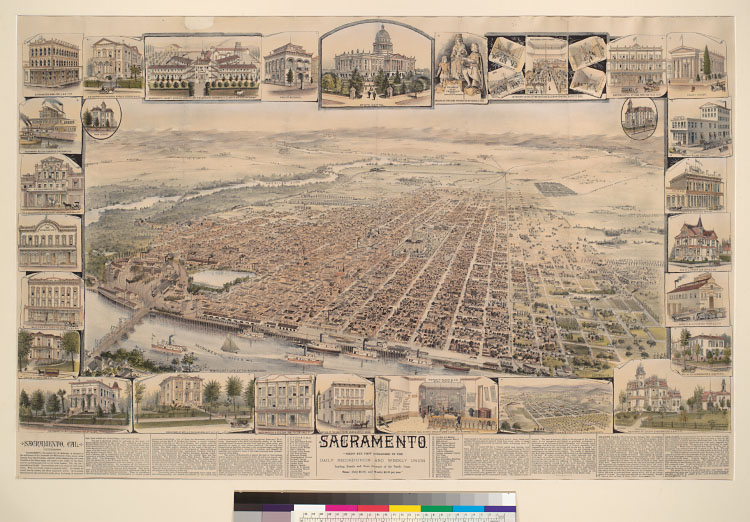
“When I look at art from the 1800s that depicts Sacramento, the name I see is The City of the Plain. It’s a lithograph by George Baker done in 1857. The inscription under the lithograph reads:
A BIRD’S-EYE VIEW OF SACRAMENTO
The City of the Plain
“So he got his image from looking down from the mountains?” he asked.
“I don’t know,” I said. “There weren’t airplanes. Maybe there was a three story building he viewed the valley from.
“What amazes me is his detail. The lithograph depicts the trees in town to be part of an overall tribute to the precision of city planning and commerce on a flat wilderness. Baker has the space between Sacramento and the mountains all flat. More like geometry’s plane than grassland. He considered a plain to be boring, rather than teeming with life like Indians and John Muir did.
“He makes it look like a vast distance of flat to the mountains, but it’s only ten miles to where the hills start in Orangevale.
“It seems to me he never stepped from his office to see the area a few people marveled at. There’s another bird’s-eye view of Sacramento done in 1870. I don’t think Baker did it, but the same sense of emptiness between town and the mountains exist. The two lithographs captured the boredom of the rice fields in the next century, rather than the home of wildflowers and buzzing bees that Muir walked through and lusted over and slept in.
“I like a painting done in 1849 by George Cooper. It has a lot of trees towering above buildings. Through the trees are the mountains. The painting is exciting and mysterious. It makes me think of how neat it would have been to live here and be part of the adventure.
“The lithographs of 1857 and 1870 make me feel that Sacramento would have been a great place to watch the mountains but a boring place to live.”
“Or the sky,” he said.
“What do you mean?” I asked.
“Without any trees, the sky would have been more important,” he said. “People would have been forced to watch it.”
“There’s a guy who agrees with what you said,” I said.
“There is?”
“Yes.”
“Go on,” he told me.
“He wrote an article in a local weekly paper in the 1980s. He said the old timers planted trees so they would not have to see the sky and be overwhelmed by God. I think he was saying that all the talk about God that the pioneers brought with them was put to the test after they destroyed the trees and had to look up and see God go up and out forever. It scared the shit out of them.”
“Kind of like you’re implying the grassland scared Baker,” he said.
“Right,” I said.
“So they planted trees to forget about their fear?”
“That’s what I think he was saying,” I said.
“What do you think?”
“What do I think?”
“Yeah.”
“I think people feared the plains and the sky. The fear they had from crossing the Great Plains and sailing on the ocean they brought with them here. I think they liked the sky at night, but the vast sky in the daytime was too much. It’s too bad. The Sioux saw the prairie as divine. The ancient Athenians loved to look at the vast sky and the ocean from their city. The ancient Irish saw spirits in trees. We didn’t see trees as divine when we cut them or when we planted them.
“We had it all going for us. Except for the fifteen years between 1855 and 1870, there were good sized trees. If you lost interest in looking at the trees, you could walk to the edge of town and climb one to look out at our great grassland and the mountains and peep through a space between branches to the sky. God was everywhere.
“I see God everywhere like the Spaniards wanted to name something after the Blessed Sacrament. The Spaniards didn’t see nature as divine, but they loved God. They were on the right track when they gave us a sacred name. Of all our names – The City of the Plain, City of Trees, River City, Capitol City, Camellia City – Sacramento is our best. What we need to do is adopt a sacred outlook to go with our sacred name. We can pray to our rivers and use the grass under oak trees as places to make love and have a baby.”
“And look up to the sky together when we finish doing it to thank God for life,” he said.
“Yes,” I choked.
“It sounds great,” he said. “How will you get it to happen?”
“I won’t,” I said. “But think of this.”
“What?”
“We can’t focus on rivers or trees because they are right here for us to touch and linger with. We don’t know how to touch or linger. We’re always reaching for the future. A view of the sky and the mountains symbolizes the future. The sky is limitless like the future. The mountains are monumental like we hope our future is.
“You can’t walk to the edge of town anymore to climb a tree to look to the mountains and all that sky between us and them. What you can do though is find a building with a view. If you work in a big office building you can walk out to the hall during break and look to the sky and mountains aching for your retirement. If you’re way up on one of the top floors where you can see the rivers and a few miles of trees too, you might feel magical, that life is really pretty good and your kids will be rich and famous like the mountains and all your grand kids will have a blast playing in our urban forest.
“We’re a city of everything. We always have been. That’s where our potential lies, in allowing everybody a view of what we have – our mountains, trees, rivers, the sky, the valley.
“We have the relatively new justice building. Supposedly the grand view is for the jurists, not reserved for the judges. Our next steps are to move the five floors of our library to the twenty-sixth to thirtieth floors of the newest skyscraper. Then we can have public parks on the roofs of future skyscrapers. Everybody who wanted a grand view could have one.”
“It sounds like you don’t get a view,” he said.
“The only view I’ve had was when I went to Sac State,” I said. “On my way to talk with my professors, I’d stand in the hall if it was winter and look to the mountains. It was beautiful.
“I didn’t think of my future though, of having a cabin in the mountains; a penthouse apartment; a private office with a view from the top. I thought of the past, when the air was clear and there were no suburbs and I could walk all over the valley and up into the Loomis Basin.
“Even in the old days,” I continued, “people didn’t focus on walking. They rode a horse, or on a wagon or buggy, a riverboat or train. Today we ride in cars. Our name the City of Trees would mean more if we walked. We could have a mystical passionate image of our city from walking and wondering, rather than a teenage lust to put Sacramento on the map that we have now.”
“But we don’t walk,” he said.
“No we don’t. It’s too bad because walking is one of the most important things if a city wants to be great or magical. With all our trees you’d think people would be walking around filled with wonder or excitement, but like you say, we aren’t.”
“So how do you get to see everything?” he asked.
“I don’t,” I said. “I take what I get. When I lived in Midtown I’d take the bus to see a friend off of 65th near Fruitridge. It was too far to walk, especially with all the cars and few trees.
“The ride through the old part of town and past Land Park is pretty with all the trees. Then you get to the end of the park and look south to all that sky. On clear days it’s great.
“I loved going out there in February and March when it’s clear and windy. I d get off the bus at 65th. As I crossed the street I’d look to my right and left – the Sierras looming bright white and the Coast Range a dreamy silhouette.
“When I got across the street I’d walk real slow past the cemetery to watch the spring grass blow. I’d stop and look. Then I’d start walking, turning to the sky to the south, then to the Sierras. When I got to the corner to turn off, I’d stop and gaze back to the Coast Range.”
“What about the rivers?” he asked.
“I get there when I can,” I said. “The bus ride through the trees, then out to all that sky and the views across the valley and to the mountains was and is beautiful. I feel lucky.”




 David Vaszko's Blog
You must be logged in to post a comment.